May 05, 2012

Vitas: Bringing China to China

Vitas is a Russian superstar, extremely popular in Asia, particularly China. His voice spans at least five octaves. I've written an introduction: Why Have I Never Heard of Vitas?

Audience pressing forward to stage, 
with bouquets and gifts

Some people think Vitas is so popular in Asia because Asians are used to men with high voices (eg Peking Opera), but I feel this is a simplistic explanation, and that something far more socio-psychological is going on there. In fact, I have taken great liberty to imagine why.

I have a theory that Vitas may be helping China to regain her ancient heritage and to heal her wounds. I believe perhaps the China is confused, embarrassed and sad that she lost 5000 years of culture in a few years. I think Vitas recognizes that China wants to rediscover herself: culturally and spiritually. The people feel an emptiness.

In some ways Vitas is also controversial, but I believe it actually makes him even more attractive to the Chinese.


Vitas: Diplomatic License

OF THE SPIRIT

One aspect of old China that Vitas stongly reappropriates is Asian spirituality, philosophy and religion- the most controversial of all. But things in China have been changing. I have read that the government does not bother the Christian churches springing up everywhere (although for the most part they are state-controlled), and most of the major monasteries have been restored. I have read that the government doesn't mind so long as it doesn't, from their perspective, get out of hand (eg Falun Gong).

Vitas dressed as Buddhist monk 
in video 'Opera 1'

Tibetan Plateau


the Tibetan Plateau
tibetantrekking.com/

In 2008, Vitas recorded a modern folk song and video about Tibet, which in itself is not strange to the Chinese; it is a song about a beautiful unspoiled* area that includes most of Tibet, part of which greater China claims. It is called the Tibetan Plateau, in Chinese, Qinghai-Tibetan (Qingzang) Plateau.

My question is, is this song controversial? This is very ambiguous.

March 30, 2012

LYRICS for Vitas in China

list of the Vitas LYRICS below:
Qinghai-Tibet Plateau (2 translations)
Opera #1
Wo Ai Ni (I Love You)
Forgive Us, Lord

You can also find most Vitas lyrics at this link


QINGHAI-TIBET PLATEAU
2008


A rehearsal, this is the clearest version. (No subtitles)
This modern folk song is in a traditional style.

The Plateau is the highest place in the world and said to be the most gorgeous. It includes most of Tibet. Both Tibetans and the entire Chinese republic are proud of it.

Vitas is brave to take on this song whose singers are famous for it, both Tibetan and otherwise from China.

I found different translations. While they all express how the beautiful landscape fills them with a connection, even a longing, for the past, some phrasing is more openly spiritual. Interesting to see how a text can be so open to interpretation.

WHEN YOU SEE TWO LINES CLOSE TOGETHER, THEY ARE TWO DIFFERENT TRANSLATIONS.
Note that the second translation is more spiritual. It is in italics.


Why Have I Never Heard of Vitas? Intro to Vitas


escorted by a dozen Chinese soldiers
to protect him from fans [video below]
AN INTRODUCTION TO VITAS & HIS MUSIC

VITAS IN CHINA

How did Vitas, the handsome young Russian pop star, a countertenor with over a five-octave range, become such an international smash and rise to be the one of the biggest celebrities in China- even though singing almost exclusively in Russian?

. . And need a dozen uniformed Chinese soldiers at the concert hall to protect him from a mob of hysterical fans, shrieking and pushing, and chanting "Vitas" -who in spite of the soldiers, manage to rip his shirt (VIDEO BELOW). Without intending to, Vitas (pronounced "Veee-tahs") seems to have become a bridge between east and west, a sort of "cultural ambassador" (to be explored in a forthcoming post).

Vitas the Great Seducer


STRONG SILENT TYPE

Vitas barely seems to have a life, he is on tour all over the world I estimate three out of four weeks a month; spends it is said 5-6 hours a day practicing various styles of song and dance, and breathing; as well as meditation and sports. Plus time for writing and composing. The rumor goes that he composes at night.

How I Wrote the Vitas Posts


I believe that to understand Vitas is TO SEE HIM IN CONCERT. That his concert performances explain everything- the effect on his fans amounting to worship; And particularly, explain his unprecedented effect on the Chinese people.

But my disclaimer is, I have never seen him in concert.
I have gathered all my facts from the web, a notoriously misleading and inaccurate method of research. Sites merely cut and paste information until every site says the same thing, giving an illusion of truth. There is no way to separate rumor from fact.

LYRICS for Vitas introductions

Lyrics from the post
Why Have I Never Heard of Vitas?

LIST of Songs in this Post:
1) Opera #2
2) Cranes Crying

3) "Mad Scene" from Lucia di Lammamoor:                   
See this post for lyrics (at end): Vitas Makes an Exception for Italian

4) Extraterrestrial Friend
5) Mama
6) The Star

  You can also find most Vitas lyrics at this link


March 29, 2012

Vitas Makes an Exception for Italian


Russian pop star Vitas major celebrity in China.
Escorted through a crowd of fans 
by a dozen Chinese uniformed soldiers
Vitas does what Vitas wants to do? For almost a decade, Vitas sang mainly in his native language, with few exceptions. The most interesting exception was Italian, because Vitas sings arias taking the female role.

Italian is the "language of song," and certainly of opera, to which Vitas aspires, in his own characteristically pop way. It shows the operatic side of Vitas, but also his flash and fire.


The Fifth Element alien
voiced by Albanian soprano
Inva Mula-Tchako
Here is one of the few official videos that is more exciting than his live videos. With some energetic golden ladies, he sings the "Mad Scene" from Donizetti's Lucia di Lammermoor. You may recognize this aria from the movie The Fifth Element, sung by an equally mysterious tender blue alien soprano.


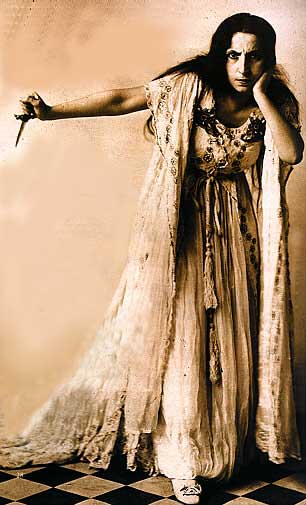
Amelita Galli-Curci 
as Lucia 1915 with Caruso
This aria is particularly famous for coloratura sopranos to show off their range and expression, adding ornamentation, turns, trills and cadenzas. The perfect opportunity for our showman Vitas to show off his over five-octave range.


Because this is opera, you know that Lucia's love story is going to go Romeo and Juliet, as it does. But the end is far more macabre: Lucia, thinking her lover doesn't love her anymore, marries another man, then on her wedding night. . . well, goes quite mad.